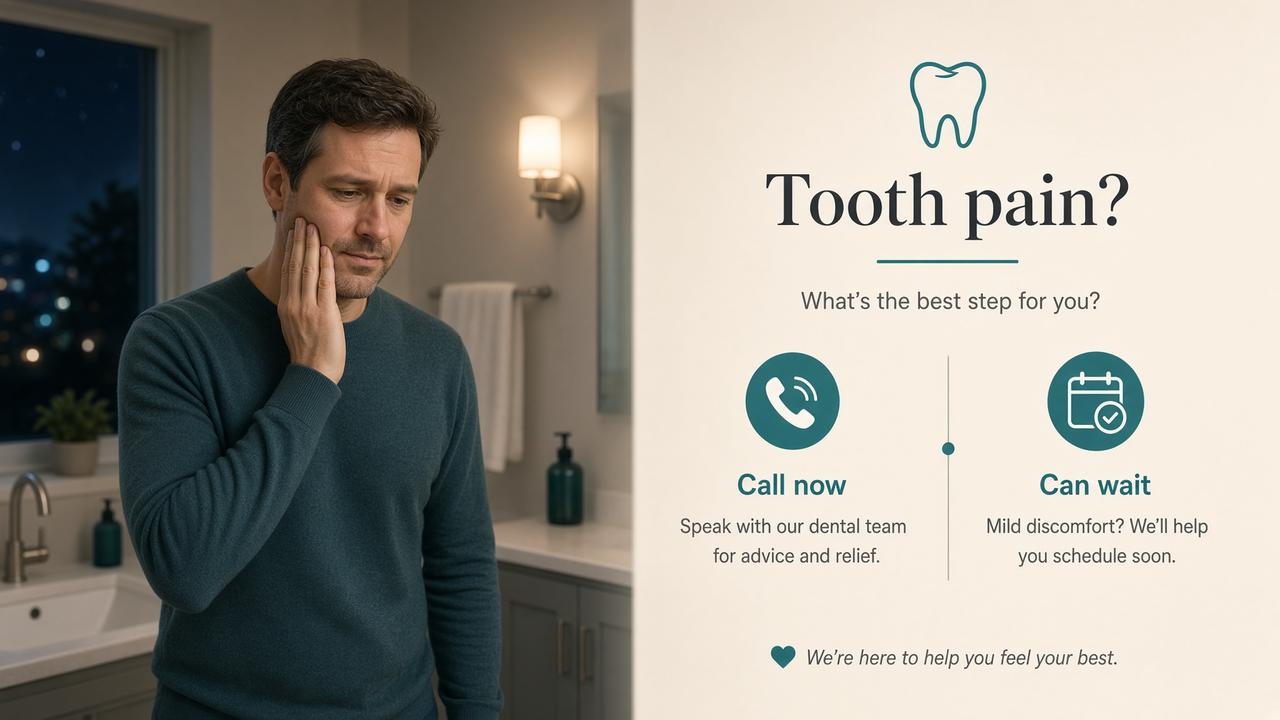
Most people do not call us because they want a lecture on dentistry.
They call because something started hurting at night, a filling came out at dinner, or one side of the face looks different than it did that morning.
The hard part is not finding a dentist. The hard part is knowing whether this can wait until we open or whether waiting is the mistake.
This article answers one question: how do we decide what is a dental emergency at Ling Zhu DDS, and what should you do if it happens when we are closed?
What's Going On Clinically
Pain is not the whole diagnosis. A tooth can hurt because of a small cavity, a cracked filling, grinding, sinus pressure, or an infection that has already left the tooth and entered the surrounding tissue.
We sort problems by risk, not by how dramatic the pain feels.
Usually urgent
Swelling in the face, floor of the mouth, or around the eye
Trouble swallowing or breathing
A tooth that got knocked out or pushed out of position
Uncontrolled bleeding after an extraction
A fever with a dental infection
Pain that is getting worse and no longer responds to what you can safely take at home
Usually urgent enough to be seen soon, but not always the same night
A broken tooth with a sharp edge
A lost crown or large filling
A toothache that wakes you up
A pimple on the gum with a bad taste
Usually able to wait for a regular visit
Mild sensitivity to cold that fades quickly
A small chip with no pain
A loose permanent retainer wire that is not cutting the lip
A dull ache that has been the same for weeks
The danger is treating facial swelling like "just a toothache." Swelling means the infection may no longer be confined to the tooth.
How We Evaluate This at Ling Zhu DDS
At 5601 Kanan Road, Dr. Zhu or Dr. Chen does not start with "Let's do a root canal." We start with where the problem is and how fast it is changing.
A typical urgent visit includes:
Your history: when it started, what makes it worse, and whether you have swelling or fever
An exam of the tooth, gums, bite, and face
Digital X-rays to look for decay, a crack, an abscess, or a failed restoration
A percussion and cold test when we need to know if the nerve is inflamed or already dying
A decision about whether we can treat in-house today or need to stabilize first
What we look for is simple: is this a tooth we can save in this office, a tooth that needs to be quieted today and treated later, or an infection that needs a physician or ER if the airway is involved?
Agoura Hills patients often ask if they should go to the emergency room. For most isolated toothaches, the ER can only give temporary pain control. They usually cannot finish the dental treatment. The ER is the right place if swelling is spreading, breathing or swallowing is affected, or you feel systemically ill.
We treat many emergencies in-house: lost fillings, broken teeth, urgent exams, drainage of a localized swelling when appropriate, and starting root canal treatment when the tooth can be saved here. If the case needs a specialist (difficult endodontics, facial trauma, or hospital-level infection care), we say so instead of stretching the visit.
Options and What To Do Next
If you are in pain and we are open
Call (818) 991-8881. Tell the front desk whether there is swelling, fever, or a tooth that was knocked out. That changes how quickly we try to see you.
If a tooth was knocked out
Hold it by the crown, not the root. If it is dirty, rinse it gently with milk or saline. Do not scrub it. If you can, place it back in the socket. If you cannot, keep it in milk or in your own saliva and come in immediately. Time matters: the best chance of saving an adult tooth is when it is put back or seen as soon as possible, ideally within the first hour. Baby teeth that are knocked out should not be put back in; call us so we can check the area.
If a crown or filling came off
Keep the piece. Do not use household glue. A little dental temporary material from a pharmacy can cover a sharp edge until we see you. The exposed tooth can become sensitive quickly.
If your face is swelling
Do not wait for the weekend to "see if it goes down." Call us. If you cannot reach us and the swelling is spreading, go to urgent medical care or an ER.
If it is only sensitivity
Rinse with warm salt water, avoid chewing on that side, and schedule a regular exam. Sensitivity alone is not an excuse to ignore a cracked tooth, but it is also not automatically a 9 p.m. crisis.
We do not promise that every emergency can be finished in one visit. Sometimes the first goal is to stop the infection or cover the tooth. The complete repair may come on a planned appointment.
What to Do While You Wait
These steps do not replace care, but they can make the hours before your visit easier and safer.
For a toothache
Rinse gently with warm salt water (about half a teaspoon of salt in a cup of warm water).
Floss gently around the tooth. Sometimes trapped food is the cause.
Hold a cold compress on the outside of the cheek, 15 minutes on and 15 minutes off.
If an over-the-counter pain reliever is safe for you, swallow it as directed on the label and note what you took and when.
Sleep with your head slightly raised if throbbing is worse lying down.
For a broken or chipped tooth
Save any pieces in a clean container, and rinse your mouth with warm water.
Cover a sharp edge with dental wax or sugar-free gum to protect your tongue and cheek.
Avoid chewing on that side, and avoid very hot, cold, or hard foods.
For something stuck between the teeth
Use floss gently, and try a knot in the floss or a water flosser.
Do not use pins, knives, or other sharp objects, which can injure the gums.
For a cut lip, tongue, or cheek
Press a clean, damp gauze or cloth firmly on the area for 10 to 15 minutes.
Use a cold compress to reduce swelling.
If bleeding does not slow with steady pressure, or the cut is deep, get urgent medical care.
For a broken braces wire or loose bracket
Cover a poking wire with orthodontic wax or a small piece of cotton.
Do not cut the wire yourself. Call us or your orthodontist.
Cost, Insurance, and Timing
Emergency visits are billed according to what we actually do: exam, X-rays, a temporary restoration, a pulpotomy or start of a root canal, or an extraction. Insurance may cover part of medically necessary emergency care. It may not cover after-hours convenience, and it may apply the same deductibles as any other visit.
We give a fee after we know the treatment, not before we have seen the tooth.
Many patients use insurance, HSA, or FSA funds. If a larger treatment is needed after the tooth is stable, ask the front desk whether CareCredit, Cherry, or Sunbit is available for that plan.
Our hours matter here.
Monday, Tuesday, Wednesday, and Friday: 9 to 6
Thursday: closed
Saturday: first and third Saturday only, 8 to 5
We see patients in English and Mandarin.
If the problem starts Thursday, do not assume it can wait until Saturday. Saturday is not always an open day.
When It Is Urgent Versus When You Can Wait
Do not wait if you have:
Facial swelling
Fever with a dental infection
Trouble swallowing or opening the mouth
A knocked-out or displaced tooth
Bleeding that will not stop
Pain plus a rapidly worsening bad taste or pimple on the gum
You can usually wait for the next open clinic day if:
The pain is mild and steady
There is no swelling
A small piece of filling or enamel came off
The tooth is annoying but you can sleep and eat on the other side
A Thursday closure is inconvenient. It is not a reason to ignore spreading swelling.
FAQ
Can I just take antibiotics and skip the visit?
Antibiotics do not fix the source of most tooth infections. They may calm swelling while we arrange treatment. They are not a substitute for seeing the tooth.
Should I put aspirin on the gum?
No. That can burn the tissue. If you use a pain reliever, swallow it as directed on the label, and tell us what you took.
What if I already have a dentist but cannot get in?
We can see you for the urgent problem. Bring any recent X-rays if you have them. We still need our own exam.
Is a lost baby tooth an emergency?
A loose baby tooth that was already wiggling is usually not. A knocked-out permanent tooth is.
Can a cracked tooth wait a month?
If it only zings with cold and then stops, it may wait a short time. If it hurts when you bite, or a piece is missing, come in sooner. Cracks get worse, not better.
What should I say when I call?
Say whether there is swelling, fever, trauma, or uncontrolled pain. That is more useful than "my tooth hurts."
Not every painful tooth is an emergency. Every swollen face deserves a same-day decision.
If you are unsure, call (818) 991-8881 or book at lingzhudds.com/contact. We would rather sort it with you than have you guess overnight.
Sources and further reading
American Dental Association, MouthHealthy: Dental emergencies
International Association of Dental Traumatology: iadt-dentaltrauma.org
American Association of Endodontists: Root canal treatment