Scroll through social media and you'll see flawless, bright, perfectly aligned smiles everywhere. It's natural to wonder whether that could be you, and whether it's worth the money.
After many consultations, we've seen patients who are thrilled with their results and a few who wish they had chosen differently. The difference almost always comes down to planning: choosing the right treatment for the actual problem, starting as conservatively as possible, and having realistic expectations. This guide covers the main options, their trade-offs, and how to decide.
What a "smile makeover" really means
There's no single procedure called a smile makeover. It's a plan that combines one or more treatments to improve how your smile looks, and ideally how it functions too. Common building blocks:
Professional whitening
Composite bonding
Porcelain veneers or crowns
Clear aligners or braces
Gum contouring
Replacing old, discolored fillings or crowns
For some people, the right "makeover" is just whitening and a little bonding. For others, it's aligners first, then a few veneers. Starting with the problem you want to solve, not with a specific procedure, usually leads to a better result.
The main options, from most to least conservative
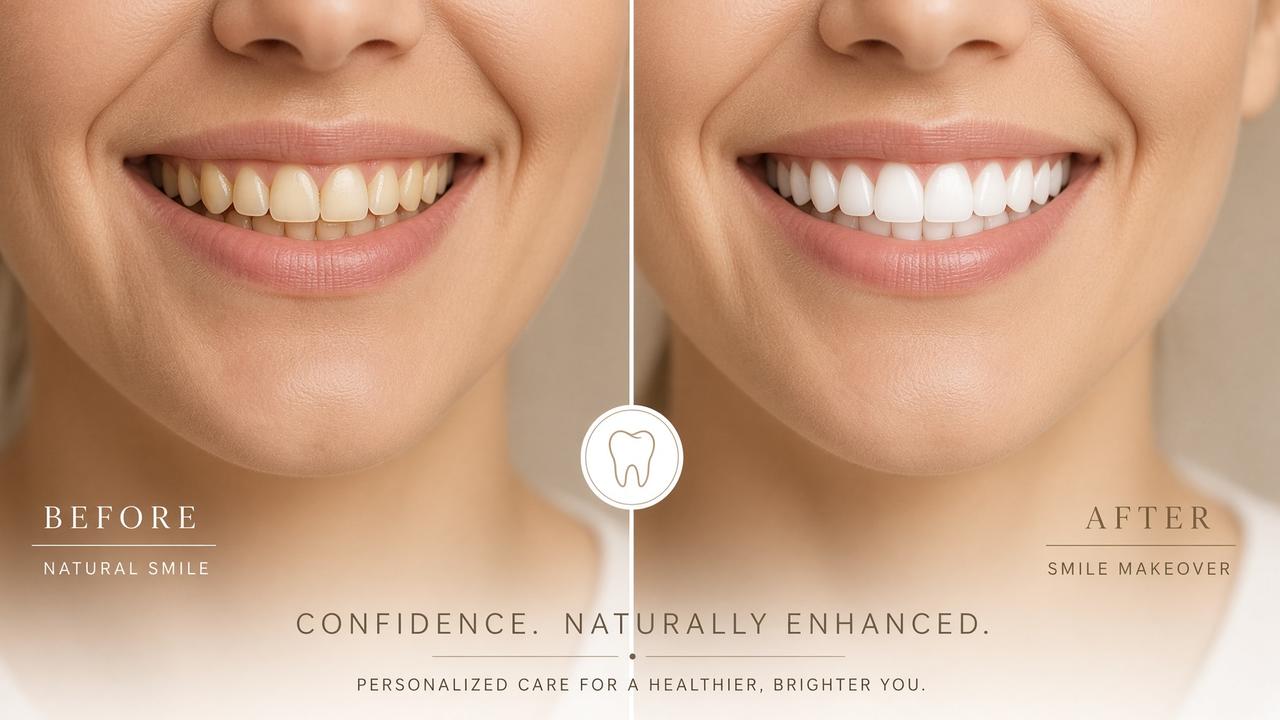
Professional whitening - Best for: teeth that are well shaped and aligned but yellowed or stained, for example from coffee, tea, or age. - Pros: non-invasive, relatively affordable, and doesn't remove tooth structure. - Cons: results vary, it doesn't change existing fillings or crowns, and it needs maintenance. Temporary sensitivity is common. - Tip: whiten before any bonding or veneers, since those are color-matched to your teeth at the time they're made.
Clear aligners or braces - Best for: crowding, spacing, and some bite problems. - Pros: moves your own teeth, preserving tooth structure. Straightening first often means fewer teeth need veneers later, or none at all. - Cons: takes months. Aligners only work if you wear them as directed, usually most of the day. Retainers are needed afterward to keep the result.
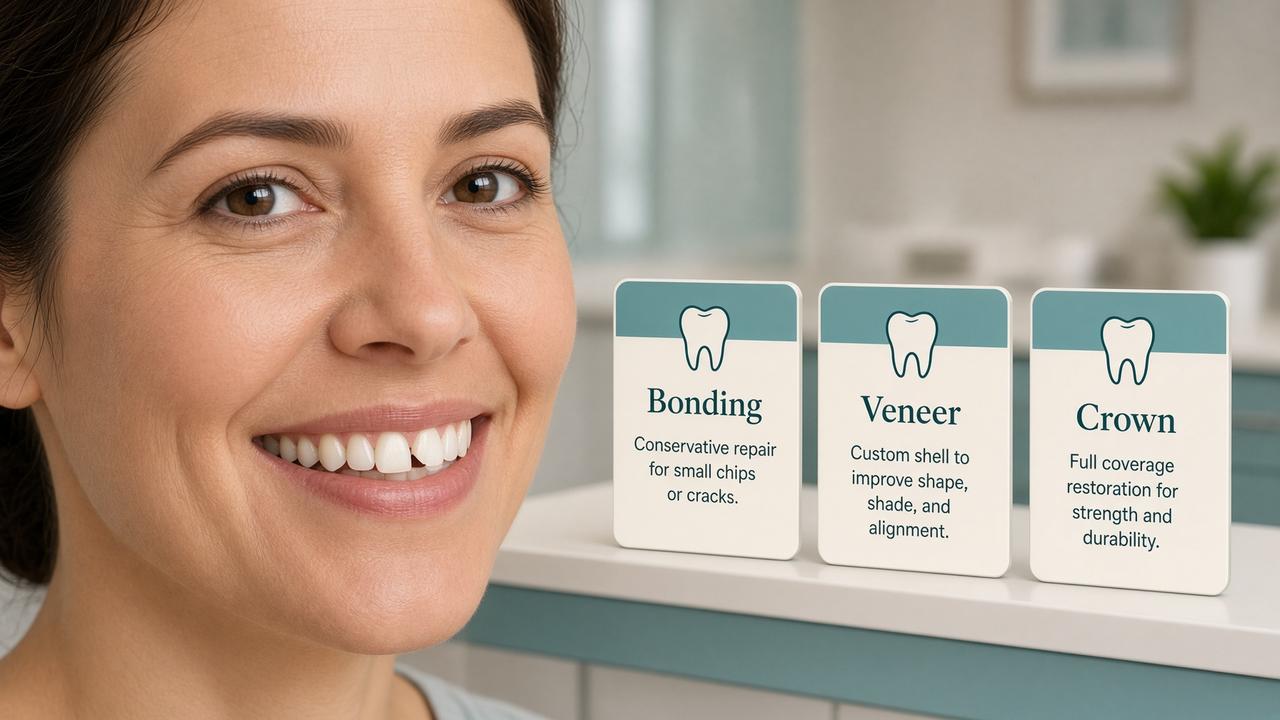
Composite bonding - Best for: small chips, gaps, uneven edges, and minor shape changes. - Pros: usually little or no drilling, often done in one visit, repairable, and less expensive than porcelain. - Cons: stains and wears more than porcelain over time, and needs touch-ups or replacement.
Gum contouring - Best for: a "gummy" smile or uneven gumlines. - Pros: can make teeth look more proportional. It's sometimes combined with other treatments. - Cons: it's a surgical procedure that needs careful planning. It isn't right for everyone, especially when a gummy smile has a skeletal cause.
Porcelain veneers - Best for: larger changes in shape, size, and color, deep internal stains, worn or chipped teeth, and teeth that don't whiten well. - Pros: very natural-looking and stain-resistant when done well, with a result that can last many years. - Cons: usually requires removing some enamel, which is permanent. Veneers eventually need replacement, and one can chip. Overly white, uniform veneers can look artificial.
Cost and long-term upkeep
Fees vary widely by the number of teeth, materials, lab, and complexity. As a general order, from least to most expensive per tooth: whitening, bonding, then porcelain veneers. Aligners are priced by the case. Many consumer guides cite porcelain veneers at roughly $1,000 to $2,500 or more per tooth, so a full upper smile can reach five figures. Insurance rarely covers purely cosmetic treatment.
The upfront fee isn't the whole cost. Plan for:
Replacing veneers, bonding, or crowns in the future
Retainers after orthodontic treatment
A night guard if you grind, to protect your new work
Touch-up whitening
Regular cleanings and checkups, which matter even more once you have restorations
A written estimate should list every stage, including any preliminary work such as treating cavities or gum disease first.
Who tends to be happiest
Patients are usually most satisfied when:
They have clear, specific goals, such as "close this gap" or "fix these chipped edges"
Their gums and teeth are healthy before cosmetic work starts
The plan starts with the most conservative option that can reach their goal
They have previewed the result with a mock-up or digital design
They understand the maintenance and future replacement costs
Disappointment is more likely when:
The goal is based on filtered photos, or a very white, uniform "perfect" look
Bite or gum problems are ignored
Irreversible treatment is chosen when a reversible option would have worked
The decision is rushed
Whitening and bonding vs veneers
Many people assume they need veneers when whitening, bonding, or straightening would get them most of the way there, for far less and without removing enamel. Whitening and bonding make sense when the teeth are basically well shaped and the concerns are color and small defects. Veneers make more sense when there's significant wear, chipping, irregular shape, or internal discoloration that won't whiten.
How to avoid regret
Ask what problem each step solves. A good plan explains why each treatment is recommended.
Ask for the conservative option first. Find out what can be done without removing tooth structure.
See before-and-after photos of cases similar to yours.
Preview the result. A diagnostic wax-up, temporary mock-up, or digital smile design lets you "test drive" the shape before anything permanent is done.
Ask about the future. What happens if a veneer chips? How long should you expect it to last? What will maintenance involve?
Take your time. A second opinion is reasonable for large, irreversible treatment.
Our approach at Ling Zhu DDS
At our Agoura Hills office, Dr. Zhu starts a cosmetic consultation by asking what bothers you about your smile. Then we check the health of your teeth, gums, and bite, because cosmetic work has to sit on a healthy foundation. We'll explain your options from most to least conservative, show you what each can realistically achieve, and give you a written estimate. We're comfortable telling you when a simpler option makes more sense. We can go over everything in English or Mandarin.
The bottom line
For the right person, with a careful plan and realistic expectations, a smile makeover can be very worthwhile. Often the best result comes from combining conservative steps, such as whitening, aligners, and bonding, and using veneers only where they're truly needed.
Curious about what's possible for your smile? Request a cosmetic consultation with Ling Zhu DDS Dental in Agoura Hills.
Sources and further reading
American Dental Association, MouthHealthy: Veneers
American Dental Association, MouthHealthy: Whitening
American Association of Orthodontists: Patient information