Gum pain is one of the most common concerns we hear at Ling Zhu DDS Dental. Sometimes it's minor, like a scrape from a tortilla chip or irritation from brushing too hard. Other times, it's an early sign of gum disease or an infection that needs treatment. Because gum problems are often painless in their early stages, pain is worth paying attention to.
Here's how to think about the common causes, what you can do at home, and when to call.
Where is the pain, and what does it feel like?
One spot, sharp, after eating: often a small injury or trapped food, like a popcorn hull or seed.
One spot, throbbing, with swelling or a bump: could be an abscess or infection.
Widespread tenderness, redness, and bleeding when brushing: typical of gingivitis.
Soreness around a back tooth that is coming in: often a partially erupted wisdom tooth.
Rubbing or pressure under an appliance: a denture, partial, retainer, or aligner edge.
Common causes
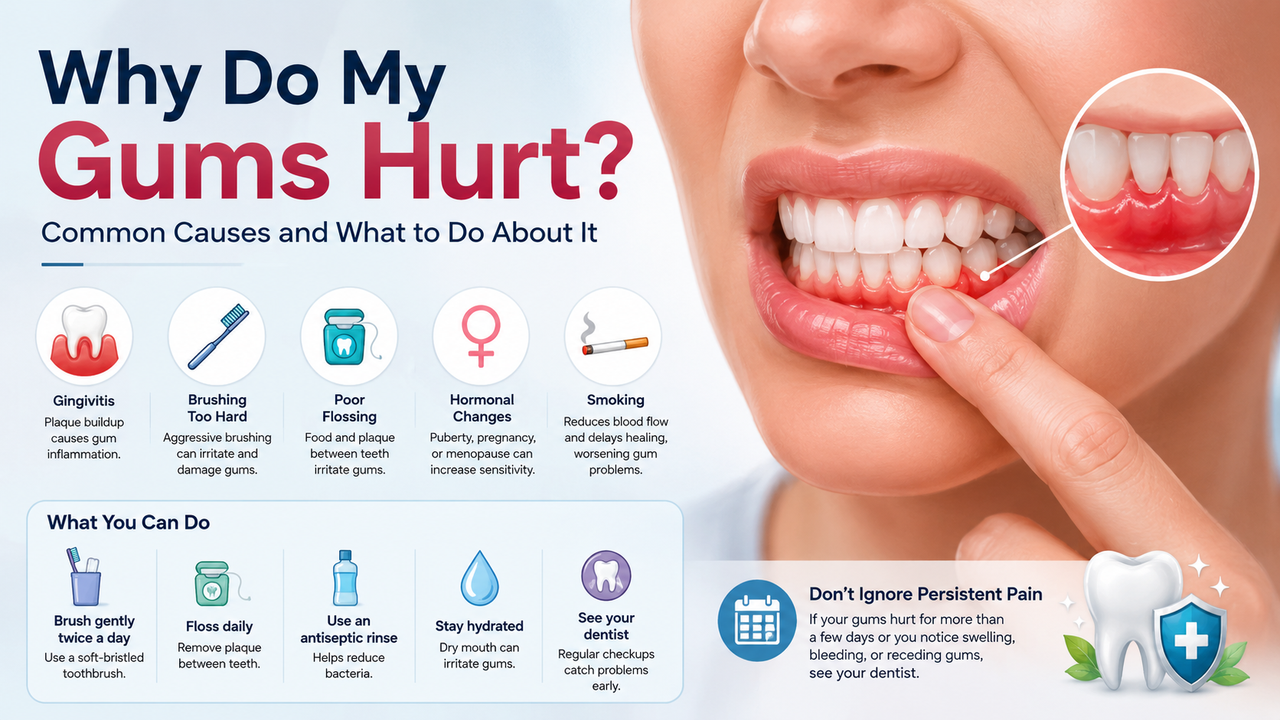
Gingivitis. Plaque along the gumline irritates the gums, making them red, puffy, tender, and prone to bleeding. The encouraging part is that gingivitis is usually reversible with a professional cleaning and consistent brushing and cleaning between the teeth.
Periodontitis. If inflammation continues, it can damage the bone and tissue that hold teeth in place. Pockets form between the gums and teeth, gums may recede, and teeth can loosen. Periodontitis is often not very painful until it's advanced, which is why regular checkups matter.
Brushing or flossing too hard. A hard-bristled brush or aggressive scrubbing can injure gum tissue and contribute to recession. Use a soft brush with gentle pressure.
Food impaction. Food wedged between teeth, especially where there's a gap or an open contact next to a filling, can cause sharp, localized soreness.
Abscess or infection. A gum or tooth infection can cause throbbing pain, swelling, a bad taste, and sometimes a pimple-like bump. It needs dental treatment.
Wisdom teeth. Gum tissue over a partially erupted wisdom tooth can trap food and become inflamed (pericoronitis). It can cause pain, swelling, and difficulty opening wide.
Hormonal changes. Puberty, pregnancy, and other hormonal shifts can make gums more reactive to plaque. Pregnancy gingivitis is common, and dental cleanings are safe and recommended during pregnancy.
Canker sores and mouth injuries. Small ulcers or burns from hot food can make gum tissue sore for several days.
Appliances. A new or poorly fitting denture, partial, retainer, or aligner can rub the gums.
Tobacco and vaping. Both are associated with gum disease and slower healing, and smoking can mask bleeding, hiding early warning signs.
Medical conditions and medications. Diabetes is closely linked with gum disease. Some medications can cause gum overgrowth or dry mouth. Tell us about your health history and medications, because they affect how we plan care.
What helps at home
Warm salt-water rinses: about half a teaspoon of salt in a cup of warm water, a few times a day.
Gentle, thorough cleaning: a soft brush angled toward the gumline, and gentle cleaning between the teeth. It may feel counterintuitive, but continuing to clean inflamed gums gently helps them heal.
Remove trapped food carefully with floss. Don't use sharp objects.
Over-the-counter pain relievers, taken as directed on the label, if they're safe for you. Don't place aspirin on the gums, because it can burn the tissue.
A cold compress on the outside of the cheek for swelling.
Avoid irritants such as spicy or very acidic foods and tobacco while the area heals.
If the soreness is from a minor injury or trapped food, it should improve within a few days.
When to see a dentist
Call for a visit if:
The pain lasts more than a few days or keeps coming back
Your gums bleed regularly when you brush or floss
You notice gum recession, loose teeth, or a change in your bite
There's a bump on the gum or a bad taste from one spot
Seek care urgently if you have swelling in the face or jaw, fever, trouble swallowing or opening your mouth, or pain that is getting worse quickly.
How we evaluate and treat gum pain
At our Agoura Hills office, we examine the gums, measure the pocket depths around each tooth, and take X-rays when needed to check the bone and look for infection. That tells us whether we're dealing with irritation, gingivitis, periodontitis, an infection, or a problem tooth.
Treatment depends on the cause:
Gingivitis: a professional cleaning and a home-care plan.
Periodontitis: often a deep cleaning below the gumline (scaling and root planing), followed by more frequent maintenance visits. More advanced cases may need periodontal surgery.
Infection: treating the source, such as draining an abscess, treating the tooth, or removing it if it can't be saved. Antibiotics are sometimes used alongside treatment but aren't a substitute for it.
Appliance irritation: adjusting or replacing the appliance.
Our team includes Dr. Leshin Chen, a board-certified periodontist, so patients who need specialized gum care can often be treated in the same office. We see patients in English and Mandarin.
The bottom line
Occasional gum soreness from a minor injury usually fades quickly. Gums that bleed, recede, or hurt repeatedly are telling you something, and gum disease is easiest to treat early.
Gums bothering you? Request an appointment with Ling Zhu DDS Dental in Agoura Hills.
Sources and further reading
American Academy of Periodontology: Gum disease information
National Institute of Dental and Craniofacial Research: Periodontal (gum) disease
CDC: Oral health