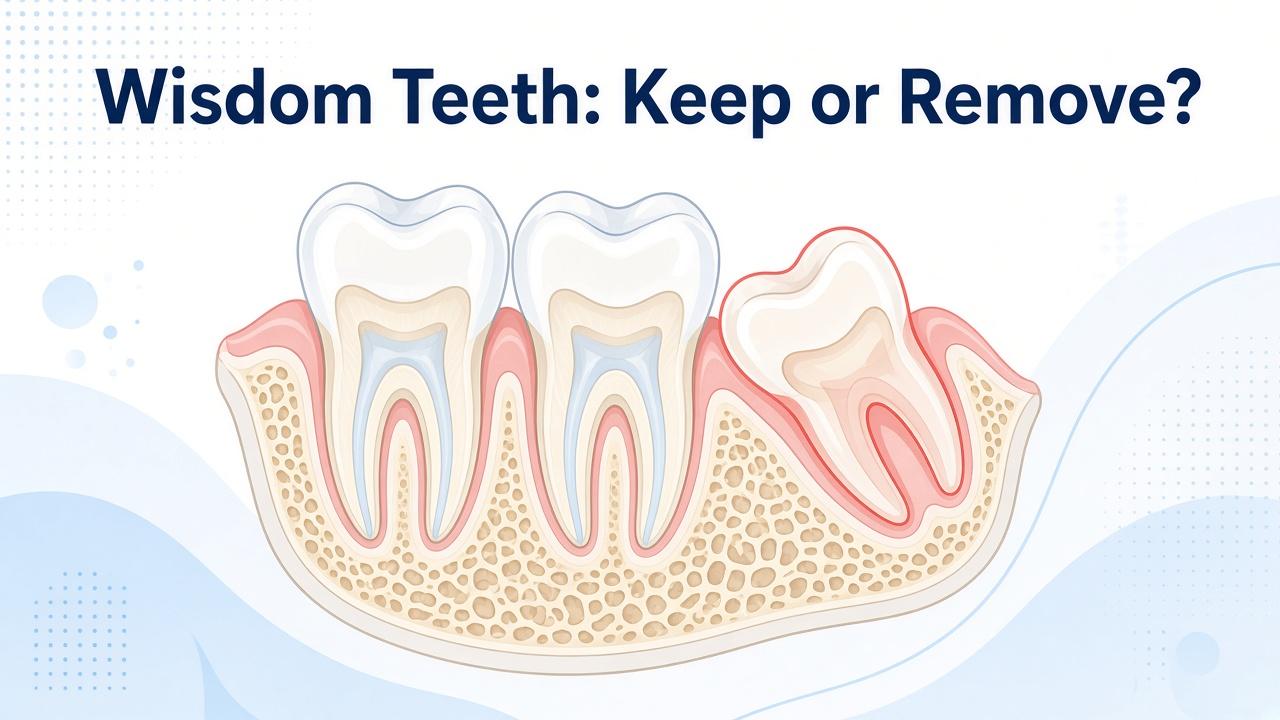
"Do I have to get my wisdom teeth out?" is one of the most common questions we hear from teenagers, college students home for break, and their parents. We also hear it from adults in their 30s and 40s who were told years ago to "keep an eye on them" and never heard anything more.
The honest answer is: not always. Wisdom teeth are not a problem just because they exist. Some people keep healthy wisdom teeth for life. Others have teeth that are trapped, tilted, or only partly through the gum, and those can cause trouble that is easier to prevent than to fix. This guide explains how we tell the difference, which warning signs matter, and what happens if removal turns out to be the right call.
What wisdom teeth are, and why they cause trouble
Wisdom teeth are your third molars, the last teeth at the very back of the mouth. According to the American Dental Association's MouthHealthy site, they usually come in between the ages of 17 and 21. When they come in straight and have enough room, they work like any other molar.
Problems start when there isn't enough space. A wisdom tooth that is stuck under the gum or in the jawbone is called impacted. MedlinePlus, the National Library of Medicine's health site, notes that impacted teeth may cause no problems for some people and may not need treatment. A tooth can also come in only partway, or at an angle, pushing toward the molar in front of it.
Being impacted is not an emergency on its own. What matters is whether the tooth is causing, or is likely to cause, damage.
Why some wisdom teeth become a problem
These are the issues we look for as wisdom teeth develop:
Trapped food and decay. A tooth that sits at an odd angle creates a pocket where food and bacteria settle. That can lead to cavities on the wisdom tooth or on the healthy molar next to it.
Hard-to-clean spaces. Even careful flossers often can't reach the gap between a tilted wisdom tooth and its neighbor.
Gum infection around a partly erupted tooth. When a tooth is only partly through, a flap of gum covers part of it. MedlinePlus explains that food and debris trapped there can inflame the gums, cause tenderness and an unpleasant odor, and that this is called pericoronitis.
Cysts. Less commonly, the ADA notes that an impacted tooth can form a cyst that may damage the roots of nearby teeth or the bone that supports them.
Damage to the neighboring molar. Decay and gum problems on the second molar are a big reason we pay attention to a wisdom tooth that looks harmless on its own.
You may also hear that wisdom teeth "crowd" the front teeth. The ADA describes this as something "thought by some," which means it's debated. We don't recommend removing healthy wisdom teeth only to protect a straight smile, but if you've had braces or Invisalign, we'll look at the whole picture with you.
Signs you should have your wisdom teeth checked
Call us if you notice any of these at the back of your mouth:
Pain or tenderness in the gums or jaw behind your last molar
Red, swollen gum tissue over a tooth that's partly through
A bad taste or bad breath that keeps coming back from one area
Jaw stiffness or difficulty opening your mouth fully
Food getting stuck in the same spot behind your back teeth
Swelling that seems to come and go in the same place
Call promptly if you have swelling in your face or jaw, fever, swollen glands in your neck, or pain that keeps getting worse. Those can be signs of an infection that shouldn't wait for a routine visit.
How we decide: keep, watch, or remove
There's no single age or rule that fits everyone. The ADA's guidance is that your dentist examines your mouth and takes X-rays, and then you decide together. Here's how that works in our office.
1. We look at the X-ray first. An X-ray shows what we can't see in the mouth: the angle of the tooth, how much room there is, how developed the roots are, and how close the roots sit to the nerve in the lower jaw.
2. We check the tissue around the tooth. We look for gum swelling, deep pockets, decay on the wisdom tooth or the molar in front of it, and whether you can actually keep the area clean at home.
3. We place the tooth in one of three groups.
Keep - What it means: The tooth is fully in, upright, healthy, and you can brush and floss it. What happens next: It stays. We check it at your regular visits.
Watch - What it means: No problem yet, but its position means one could develop. What happens next: We re-check it with X-rays over time. The ADA says wisdom teeth that aren't removed should continue to be monitored.
Remove - What it means: There's evidence of changes such as pain, infection, cysts, damage to neighboring teeth, gum disease, or decay that can't reasonably be repaired (the ADA's list). What happens next: We explain the plan, the comfort options, and recovery before you decide.
Why timing matters
If a wisdom tooth is likely to need removal, earlier is often easier. MedlinePlus notes that having wisdom teeth removed before age 20 often has better results than waiting, because the roots are not yet fully developed. As we get older, the roots grow longer and the bone becomes firmer, which can make removal and healing harder.
That doesn't mean every teenager needs surgery. It means a check-up with an X-ray in the mid-to-late teens is a smart time to make the decision, rather than waiting for the first painful infection.
Your wisdom tooth visit checklist
Bring these questions to your appointment (or your teen's). They help you leave with a clear answer instead of "we'll see":
Which of my wisdom teeth are in: all four, some, or none?
For each one, is it in the keep, watch, or remove group, and why?
Is any of them affecting the molar in front of it?
How close are the lower roots to the nerve?
If we're watching, when is the next X-ray?
If removal is recommended, what are my comfort options, and what does recovery look like for my situation?
What does my dental insurance cover for this visit and for treatment? (Our front desk can help you check.)
What to tell us when you call. It helps to say which side hurts (upper or lower, left or right), how long it has been going on, whether there's swelling or a bad taste, and whether you've had a fever. That lets us decide how soon you should be seen.
What happens if removal is recommended
Wisdom tooth extraction and sedation dentistry are among the services listed on our Services page. If removal is the right choice, we'll explain exactly what the procedure involves for your teeth, which comfort options fit your situation, and what to plan for afterward.
Before the procedure. We review your medical history and medications and walk you through the plan. If the area is infected, MedlinePlus notes that antibiotics may be prescribed before the tooth is removed.
The first few days. Some swelling and soreness are normal. You'll go home with written instructions for eating, cleaning, and pain control.
Protecting the blood clot. After an extraction, a blood clot forms in the socket and protects the bone and nerves underneath while it heals. The ADA describes dry socket as what happens when that clot is displaced and leaves bone and nerves exposed, and says to contact your dentist if it happens. Treatment can include cleaning the socket and placing a medicated dressing. The ADA also notes that smoking and other tobacco use can delay healing, so it's best to avoid them while you recover.
Call us if pain gets stronger after the first few days instead of easing, or if you have fever, swelling that's getting worse, or a bad taste that won't go away.
Frequently asked questions
My wisdom teeth don't hurt. Do they still need to be checked? Yes. An impacted tooth can be painless, and problems like decay on the neighboring molar or a cyst can develop quietly. An X-ray is the only way to see what's happening below the gum.
Is it ever okay to keep my wisdom teeth? Yes. If they're healthy, upright, and easy to clean, many people keep them for life. We simply keep checking them at regular visits.
I'm over 30. Is it too late to have them evaluated? No. Adults have wisdom teeth evaluated, and removed when needed, at any age. Healing can take a bit longer as we get older, which is one more reason to plan ahead rather than wait for an emergency.
Can a gum infection around a wisdom tooth go away on its own? The swelling may calm down for a while, but if food keeps getting trapped under the gum flap, it tends to come back. Rinsing gently with warm salt water can soothe the area until you can be seen, but it doesn't fix the cause.
Will removing my wisdom teeth straighten my front teeth? Not necessarily. Whether wisdom teeth push other teeth out of line is debated. If straightness is your concern, we'll talk about it along with your bite and orthodontic history.
We're here to help
If your back teeth have been sore, your teenager is due for a check-up, or you were told years ago to "watch" your wisdom teeth and never followed up, we can take an X-ray and give you a clear answer: keep, watch, or remove. Dr. Ling Zhu, Dr. Leshin Chen, and our team will explain what we see in plain language, in English or Mandarin.
Call us at (818) 991-8881 or request an appointment online. We're at 5601 Kanan Road, Agoura Hills, CA 91301, open Monday, Tuesday, Wednesday, and Friday from 9 to 6, and the 1st and 3rd Saturday of each month from 8 to 5 (closed Thursdays). 我们提供中文服务。
Sources
American Dental Association, MouthHealthy: Wisdom Teeth
American Dental Association, MouthHealthy: Dry Socket
MedlinePlus, U.S. National Library of Medicine: Impacted tooth
This article is general information, not a diagnosis. See our Medical Disclaimer.