Choosing between Invisalign and traditional braces is one of the biggest decisions patients face when considering orthodontic treatment. Both options can deliver beautiful results, but they work very differently.
With major advancements in clear aligner technology, the gap between the two has narrowed significantly. So which one is truly better in 2026?
We break it down honestly based on clinical data, patient outcomes, and real-world experience at Ling Zhu DDS.
How They Work
Traditional Braces
Metal or ceramic brackets are bonded to the teeth and connected by wires. The orthodontist adjusts the wires every 4–8 weeks to gradually move the teeth.
Invisalign
A series of custom-made, nearly invisible clear aligners are worn for 1–2 weeks each. Every set is slightly different, slowly shifting teeth into the desired position. You change them at home.
Effectiveness & Treatment Results
Winner: Traditional Braces (Slight Edge)
Traditional braces are still considered the gold standard for complex cases involving severe crowding, large gaps, significant bite issues, or rotated teeth. They provide more precise control because the force is applied continuously through the brackets and wires.
Invisalign has improved dramatically and can now handle many moderate to complex cases. However, it still struggles with certain tooth movements (especially vertical movements and severe rotations) compared to braces.
Success Rate:
- Traditional Braces: ~95–98%
- Invisalign: ~85–92% (higher when patient compliance is excellent)
Treatment Time
Winner: Depends on Case Complexity
- Simple cases: Invisalign is often faster (6–12 months)
- Moderate cases: Similar time (12–18 months)
- Complex cases: Traditional braces are usually faster because they don’t rely on patient compliance
Average treatment time:
- Invisalign: 12–18 months
- Traditional Braces: 18–24 months
Aesthetics & Lifestyle Impact
Winner: Invisalign (Clear Winner)
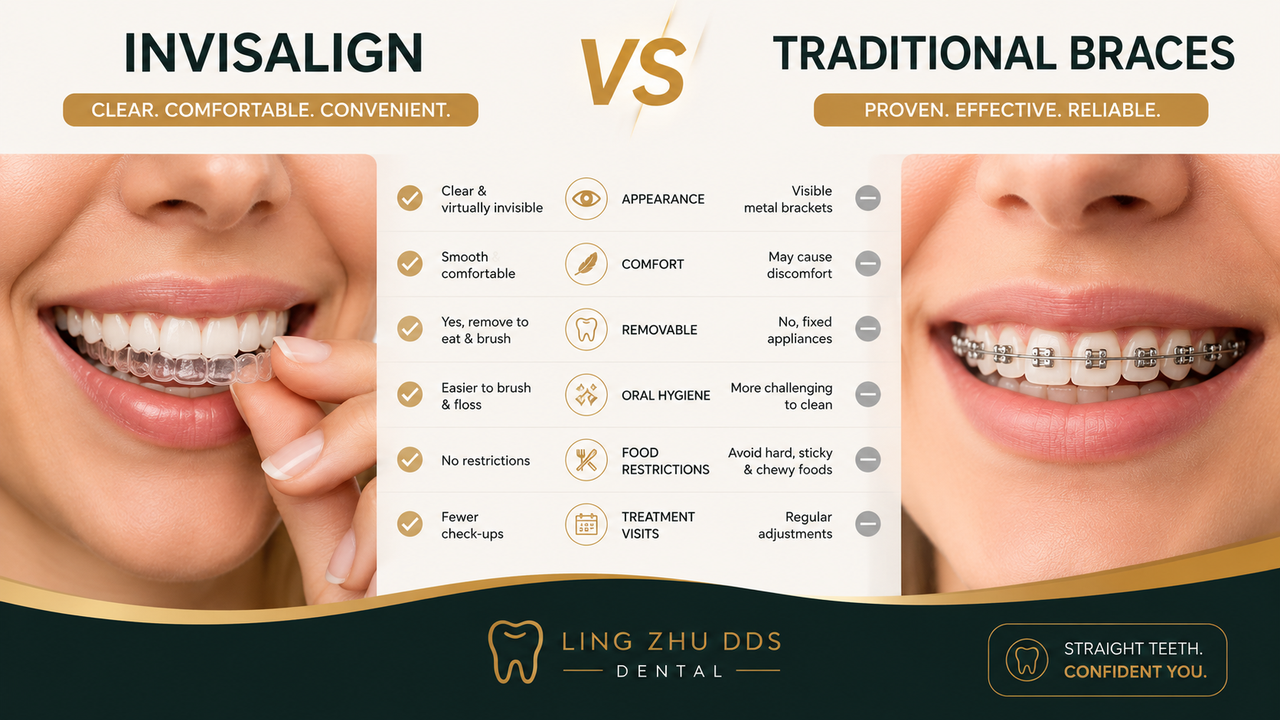
This is where Invisalign shines. The aligners are nearly invisible, making them ideal for adults, professionals, and anyone self-conscious about wearing metal braces.
You can remove Invisalign for eating, drinking, brushing, and special occasions. Traditional braces stay on 24/7.
Comfort & Pain
Winner: Invisalign
Most patients report less discomfort with Invisalign. There are no sharp brackets or wires to irritate the cheeks and lips. However, you do feel pressure when switching to a new set of aligners.
Traditional braces can cause more initial discomfort and frequent irritation from wires and brackets.
Oral Hygiene & Maintenance
Winner: Invisalign
Because you can remove the aligners, brushing and flossing are much easier. This reduces the risk of cavities and gum problems during treatment.
With braces, cleaning around brackets is challenging and requires special tools.
Cost Comparison (2026)
Traditional Braces: $5,000 – $7,500
Invisalign: $4,500 – $8,000 (varies by case complexity)
Many dental insurances cover both similarly. Invisalign is often more expensive for complex cases due to the higher number of aligners needed.
Compliance Is Everything with Invisalign
Invisalign only works if you wear the aligners 22 hours per day. For teenagers or patients who struggle with consistency, traditional braces are often the safer choice.
Our Recommendation at Ling Zhu DDS
Choose Invisalign if:
- You want nearly invisible treatment
- You have mild to moderate alignment issues
- You are highly disciplined and can wear aligners consistently
- You value comfort and easy cleaning
Choose Traditional Braces if:
- You have complex bite issues or severe crowding
- You know you won’t wear aligners 22 hours/day
- You want the most predictable results for difficult cases
- Cost is a major concern
Ready to straighten your smile?
Book your consultation with Dr. Ling Zhu at Ling Zhu DDS in Agoura Hills. We offer complimentary Invisalign and braces evaluations and will honestly recommend the best option for your specific needs and lifestyle.