Patients often ask us whether they need a "night guard" or a "mouth guard." The names sound interchangeable, and both are plastic appliances that cover the teeth. But they are designed for very different problems, and using the wrong one can leave your teeth unprotected.
Here is a clear comparison to help you decide what you need, and what to ask your dentist.
The short answer
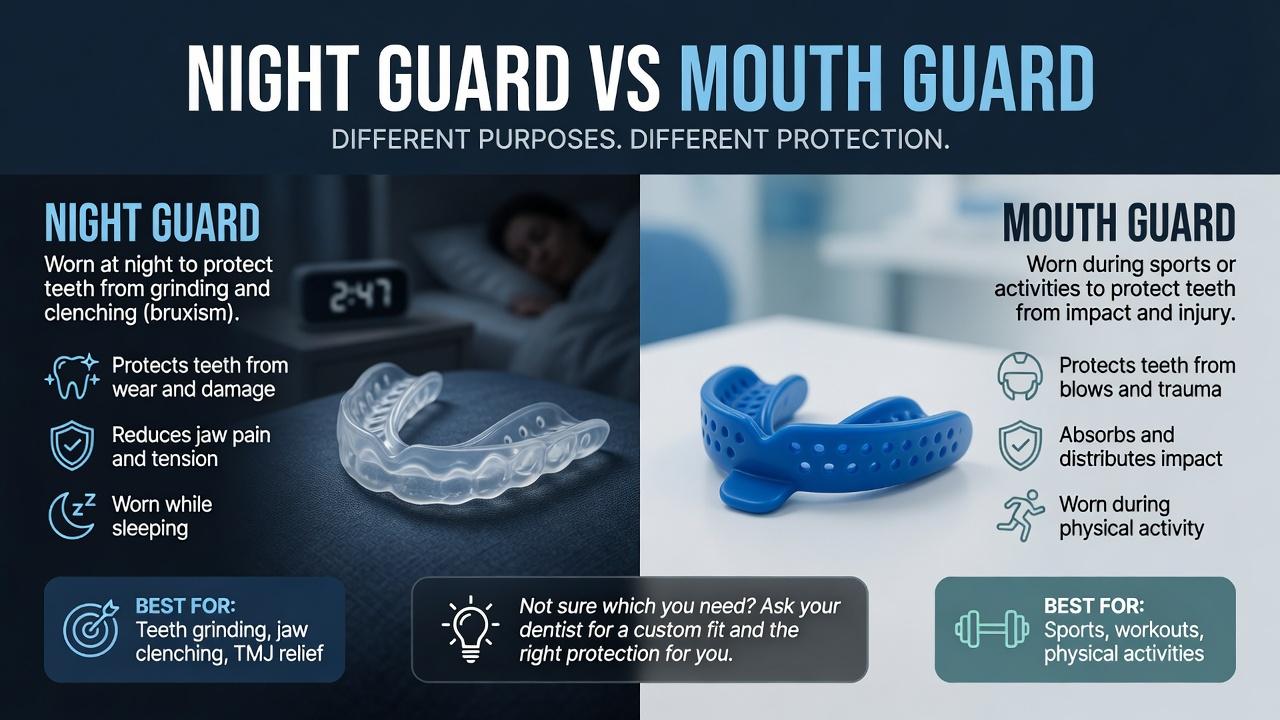
Night guard: For people who clench or grind their teeth during sleep (sleep bruxism). It protects the teeth from wear and can ease strain on the jaw muscles and joints.
Sports mouth guard: For people who play contact or high-risk sports. It cushions impact and helps protect the teeth, lips, and gums from injury.
If you do both, you'll usually need two separate appliances.
Purpose
Night guards deal with steady, repeated force. Grinding and clenching can flatten and chip teeth, crack fillings, and make teeth sensitive. A night guard puts a durable layer between the upper and lower teeth so the appliance takes the wear instead of your enamel. Many people also find their jaw feels less tired in the morning.
Sports mouth guards deal with sudden, high-energy impacts such as a ball, an elbow, or a fall. Their job is to absorb and spread the force of a blow and keep the lips and cheeks away from the teeth. The American Dental Association recommends mouth guards for a wide range of sports, not just football and hockey. Basketball, soccer, skateboarding, and martial arts are common examples.
Materials and design
Night guards are usually made of hard acrylic or a dual-layer material (soft on the inside, hard on the outside). They are relatively thin so you can sleep comfortably, and they're adjusted so your bite meets evenly on the guard. Most cover either the upper or lower teeth.
Sports mouth guards are made of thicker, softer, shock-absorbing material. They're built to stay in place during breathing, talking, and movement, and they're typically worn on the upper teeth (or on the lower teeth for patients in certain orthodontic situations).
That difference matters. A soft sports guard used at night can encourage some people to chew on it. A thin, hard night guard used in sports does not provide the cushioning needed for an impact.
Custom vs over-the-counter
Both types come in three general forms:
Stock guards: Ready to wear, inexpensive, but bulky and loose. They often make breathing and talking harder.
Boil-and-bite guards: Softened in hot water and shaped at home. They fit better than stock guards and can be a reasonable short-term option.
Custom guards: Made from impressions or a digital scan of your teeth. They fit precisely, are more comfortable, and are easier to wear consistently.
For night guards, we generally recommend custom. You'll wear it for hours every night, so fit and bite balance are important. A poorly fitting guard can be uncomfortable, and some people simply stop wearing it.
For sports, a well-fitted boil-and-bite guard is far better than nothing. A custom sports guard offers better fit and comfort, which matters for athletes who need to breathe and communicate. Children's guards need to be refit or replaced as their teeth and jaws change.
Cost
Costs vary by material and design. Over-the-counter guards usually cost much less than custom appliances. Custom night guards and custom sports guards involve impressions or a scan, lab fabrication, and a fitting visit, so they cost more. Some dental insurance plans cover part of a night guard when there's documented grinding, but coverage varies widely. Ask our front desk for a current estimate and help checking your benefits.
Care and lifespan
Rinse the guard after each use and brush it gently with a soft brush and mild soap (toothpaste can be abrasive).
Store it in a ventilated case. Keep it away from heat, such as a hot car or dishwasher, which can warp it.
Bring it to your checkups so we can look for cracks, wear, or changes in fit.
Replace a night guard when it becomes thin, cracked, or loose. Heavy grinders go through them faster. Athletes often need a new sports guard each season, and children may need one more often as they grow.
Signs you may need a night guard
Waking with sore jaw muscles or morning headaches
Flattened, chipped, or worn tooth edges
Cracked fillings or teeth
Teeth sensitivity without an obvious cause
A bed partner who hears grinding
Grinding is sometimes associated with snoring and sleep apnea. If you snore loudly or feel unrested, mention it. We may recommend a sleep evaluation with your physician, because a standard night guard isn't a treatment for sleep apnea.
How we approach it at Ling Zhu DDS
At our Agoura Hills office, we start with an exam to confirm what's going on. We check for wear, cracks, jaw muscle tenderness, and joint sounds. If a night guard makes sense, we take impressions or a scan, have the guard made, and adjust it at a fitting visit so your bite feels even. For athletes, including kids and teens, we can make custom sports guards and advise on how often they should be replaced.
We're happy to explain the options in English or Mandarin.
The bottom line
Choose a night guard for grinding and clenching. Choose a sports mouth guard for impact protection. Never use one in place of the other. If you're not sure which problem you have, an exam can tell you, and it can catch tooth wear early, before it needs bigger repairs.
Need a night guard or sports guard? Request an appointment with Ling Zhu DDS Dental in Agoura Hills.
Sources and further reading
American Dental Association, MouthHealthy: Mouthguards
American Dental Association, MouthHealthy: Teeth grinding