Losing a tooth, or being told a tooth can't be saved, usually brings up two questions right away: "Do I need to replace it?" and "Which option is right for me?"
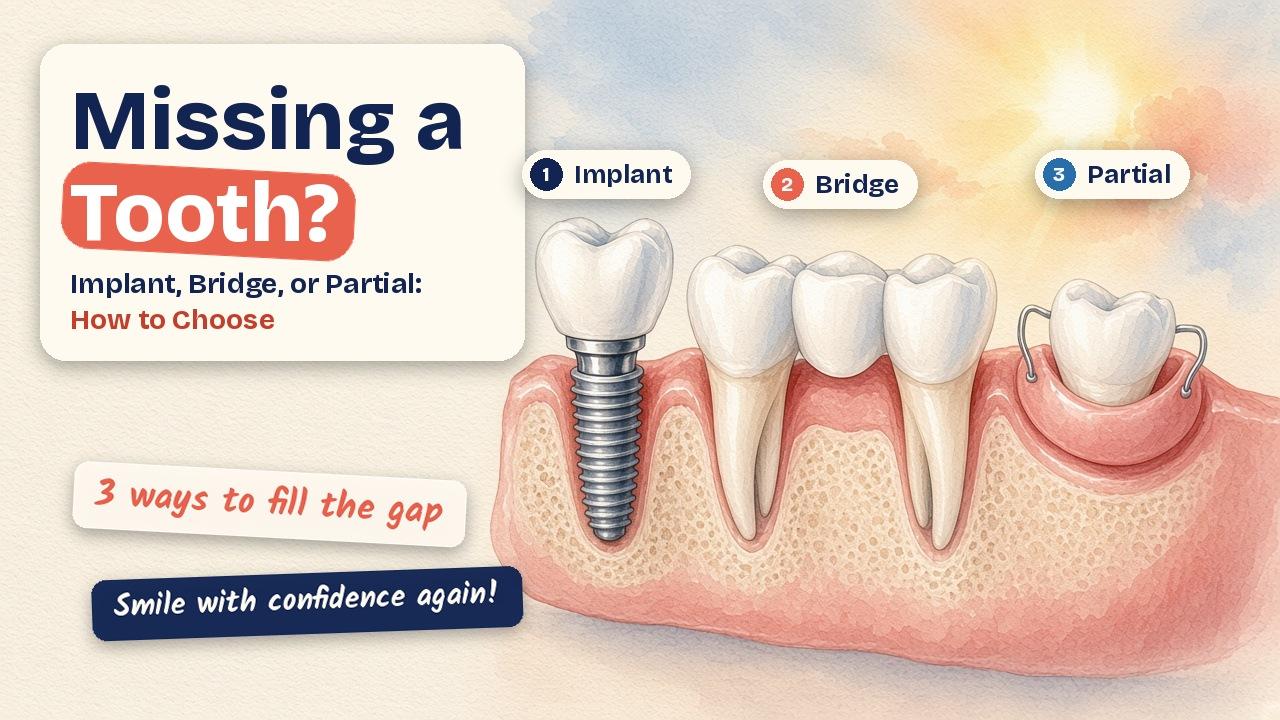
There are three common ways to replace a missing tooth: a dental implant, a fixed bridge, and a removable partial denture. Each one can work well for the right person. None of them is "best" for everyone. The right choice depends on the health of your gums and bone, the condition of the teeth next to the gap, how many teeth are missing, your budget and insurance, and how you feel about surgery or about taking something out at night.
This guide walks through how each option works, the trade-offs that matter in daily life, and a short list of questions to bring to your consultation so you leave with a clear plan instead of more uncertainty.
Why replacing a missing tooth is worth talking about
Not every missing tooth has to be replaced, and that's a fair conversation to have with your dentist. A missing wisdom tooth, for example, usually doesn't need anything. But for most other teeth, a gap can affect more than your smile:
Chewing. You may start favoring one side, which puts extra load on the teeth you have left.
Neighboring teeth. Over time, teeth next to a gap can drift or tip into the space, and the tooth above or below it can over-erupt. That can make cleaning harder and change how your bite fits together.
Bone. The jawbone that once held the tooth's root is no longer being stimulated by chewing, and it tends to shrink over time. That matters later if you decide you want an implant.
Speech and confidence. A gap near the front can change how certain sounds come out, and many people simply feel self-conscious about it.
None of this happens overnight, so there's usually time to think. But "wait and see" works best as a deliberate decision you've talked through, not a default.
Option 1: Dental implant
How it works. A small titanium post is placed in the jawbone where the root used to be. Over the following weeks to months, the bone heals around the post. This process is called osseointegration. Once it's stable, a custom crown is attached on top. According to the American Dental Association, some patients wait up to several months for the implant to integrate, while others can have replacement teeth placed in a single visit, depending on their situation.
What people tend to like:
It stands on its own, so the neighboring teeth don't need to be reshaped.
It feels and functions much like a natural tooth, and you brush and floss it like one.
Because it sits in the bone, it helps keep that area of the jaw in use.
What to weigh:
It involves a minor surgical procedure and a healing period before the final crown.
You need enough healthy bone and healthy gums. If bone has been lost, grafting may be recommended first.
Overall health matters more than age. The ADA notes that people in good general health may be candidates. Your dentist will also ask about conditions, medications, and habits like smoking that can affect healing, so your medical history is part of the plan.
The upfront cost is typically higher than the other options, though insurance may cover part of it. (See our dental implant cost guide for what affects the price.)
Option 2: Fixed bridge
How it works. A bridge "bridges" the gap with an artificial tooth that's anchored to crowns on the teeth on either side. The ADA describes it as a fixed partial denture: it's cemented in place, and only a dentist can remove it.
What people tend to like:
No surgery, and treatment is usually finished in a few visits over a few weeks.
It's fixed, so there's nothing to take out.
It can look very natural, especially in the front of the mouth.
What to weigh:
The teeth on each side have to be reshaped for crowns. That's a good trade if those teeth already need crowns or have large fillings. It's a bigger trade if they're healthy and untouched.
A bridge is only as strong as its foundation. The ADA stresses keeping the supporting teeth healthy, because decay or gum disease around them affects the whole bridge.
Cleaning takes a little extra effort. You'll need to clean under the false tooth with floss threaders, a water flosser, or small brushes.
It doesn't replace the root, so the bone under the gap isn't stimulated the way it is with an implant.
Option 3: Removable partial denture
How it works. A partial denture is a custom appliance with one or more replacement teeth attached to a gum-colored base. It's usually held in place with small clasps that rest on your natural teeth. You take it out to clean it and typically at night.
What people tend to like:
It's usually the most budget-friendly option, and no surgery is required.
It can replace several missing teeth in different spots with one appliance.
Your natural teeth need little or no reshaping.
It can be a good temporary solution while you heal or save for another option.
What to weigh:
It's removable, so there's a daily routine of taking it out, cleaning it, and putting it back.
It may feel bulky at first. The ADA notes that new dentures can feel awkward for a few weeks while your cheeks and tongue adjust, and that follow-up visits to adjust the fit are normal.
It's generally less stable for chewing than a fixed option.
Clasps can put some load on the teeth they hold, so those teeth need to stay healthy.
Side-by-side: the trade-offs at a glance
Surgery needed: Implant: Yes (minor); Fixed bridge: No; Partial denture: No
Affects neighboring teeth: Implant: No; Fixed bridge: Yes, they're crowned; Partial denture: Clasps rest on them
Removable: Implant: No; Fixed bridge: No; Partial denture: Yes
Typical time to finish: Implant: Weeks to months; Fixed bridge: A few weeks; Partial denture: A few weeks
Supports the jawbone: Implant: Yes; Fixed bridge: No; Partial denture: No
Daily care: Implant: Brush and floss like a tooth; Fixed bridge: Clean under the false tooth; Partial denture: Remove and clean daily
Upfront cost: Implant: Highest; Fixed bridge: Middle; Partial denture: Usually lowest Costs and timelines vary widely from person to person. Treat this table as a starting point for your conversation, not a quote.
A quick self-check before your consultation
Your dentist will examine your mouth and take X-rays or a 3D scan before recommending anything, but it helps to know what matters to you going in. Jot down your answers to these:
How do I feel about a minor surgical procedure? If the idea is a dealbreaker, that narrows things quickly.
Are the teeth next to the gap healthy, or do they already have big fillings or crowns? Your dentist can tell you, and the answer changes how attractive a bridge looks.
Would I be OK taking something out every night?
How soon do I need the gap filled? Is there an event coming up, or is this a longer-term plan?
What does my insurance cover this year, and how much of my annual maximum is left? If your plan resets January 1, our year-end benefits checklist can help you plan.
Do I have any health conditions or medications my dentist should know about? Bring a current list.
Questions to ask your dentist
You're allowed to ask a lot of questions. These are a good place to start:
"Which options am I actually a candidate for, and why?"
"Do I have enough bone for an implant, or would I need grafting first?"
"If we do a bridge, what would happen to the teeth on either side?"
"What would a temporary replacement look like while I heal?"
"How long does each option usually last with good care, and what maintenance should I expect?"
"Can you give me a written estimate for each option, with what insurance is likely to cover?"
"What happens if I decide to wait?"
Illustrative example: Imagine someone in their 50s who lost a lower back tooth after a crack. The teeth on both sides are healthy with no fillings, their gums are in good shape, and an X-ray shows good bone. For a person like this, an implant often comes up as a strong option because it leaves those healthy neighbors untouched. Change one detail, say the neighboring teeth already need crowns, and a bridge may make more sense. This is a sample scenario to show how the details shift the decision, not a real patient.
How we approach tooth replacement at Ling Zhu DDS
At our Agoura Hills office, Dr. Ling Zhu and Dr. Leshin Chen, a board-certified periodontist, plan tooth replacement together. That means we look at your gums and bone as carefully as the gap itself, because healthy foundations are what make any of these options last. We'll explain every option you're a candidate for, including the option of waiting, and give you a written estimate before you decide. Our team speaks English and Mandarin, so you can ask your questions in whichever language feels most comfortable.
If a tooth was just knocked out or broke today, that's a different situation. See Is this a dental emergency? and call us right away.
FAQ
Is it OK to leave a gap if it doesn't bother me? Sometimes, yes, especially for teeth that don't do much chewing. But neighboring teeth can shift and bone can shrink over time, so it's worth having your dentist check the area and help you decide on purpose rather than by default.
Am I too old for a dental implant? Age alone usually isn't the deciding factor. The ADA notes that your general health matters more than your age. Your dentist will review your medical history and imaging.
Can a bridge be replaced with an implant later? Often, yes, though the details depend on your bone and the health of the supporting teeth at that time. Ask about this if you're choosing a bridge now but want to keep options open.
Do partial dentures hurt? Some soreness and awkwardness in the first few weeks is common while your mouth adjusts. Persistent sore spots usually mean the fit needs a small adjustment, so let your dentist know rather than putting up with it.
Does insurance cover implants, bridges, or partials? Many dental plans cover part of at least one of these options, but coverage varies a lot. Our front office can check your benefits before treatment so you know your expected out-of-pocket cost.
Ready to talk through your options?
If you're missing a tooth or have been told one may need to come out, we're happy to walk you through what fits your mouth, your schedule, and your budget. Call (818) 991-8881 or request an appointment online. We're at 5601 Kanan Road in Agoura Hills, open Monday, Tuesday, Wednesday, and Friday from 9 to 6, and on the 1st and 3rd Saturday of each month from 8 to 5. We're closed Thursdays.
Sources
This article is general information, not a diagnosis. Your dentist can recommend what's right for you after an exam.